What brands really need in 2025
Packaging in the luxury goods market is at a turning point. Brands are faced with growing expectations: sustainability, design innovation and emotionalisation are no longer optional extras, but a must.
By 2026, the majority of luxury product buyers will belong to Generation Z and the millennials. These target groups make purchasing decisions not only based on price or function, but also on values. For them, future-proof packaging is visible proof that a brand is taking social responsibility and embracing innovation.
Luxury packaging must therefore be functional, emotional and environmentally friendly, while also being economically and regulatorily viable.
Why luxury packaging will have to do more than just look good in 2025
Luxury packaging is no longer a passive wrapping product. It plays a central role in brand communication. 67% of luxury shoppers expect brands to reflect the society in which they live. This means that packaging must express an attitude. Visibly, tangibly and credibly.
A chic case without a sustainable background is counterproductive today. Consumers recognise greenwashing and demand authentic solutions that are consistently implemented from materials to design to production.
At the same time, the industry is under economic pressure. Resilience in uncertain markets means choosing packaging systems that are scalable, efficient and future-proof. Companies that invest in sustainable packaging early on gain competitive advantages. Both in the minds of consumers and in terms of regulations.
What future-proof packaging really means and what brands should be looking out for now
In the luxury segment, „future-proof“ means more than just environmentally friendly. Brands must ensure that their packaging is simultaneously:
- ecological (CO₂-reduced, recyclable, resource-saving),
- has an emotional impact (creates unboxing moments),
- is functionally convincing (logistically practical, robust),
- and remains scalable (from small batches to mass production).
Future-proof packaging is therefore a strategic investment in brand strength, cost stability and consumer loyalty.
New consumer generation: Why Gen Z & Millennials are rewriting the rules
The young consumer generation is radically changing the rules of the game:
- 58% of Gen Z make emotional purchases. Packaging that triggers emotions increases willingness to buy.
- 66% of luxury shoppers remain loyal to brands they encounter early on. This means that first brand experiences are crucial, and packaging plays a key role in this.
For luxury brands, this means that packaging is not just a carrier of products, but also of brand memories. Those who manage to establish a connection when the product is first opened will gain long-term loyalty.
Packaging as a brand ambassador: more than just protection, an emotional experience
Unboxing is now part of brand staging. Packaging is the first physical contact between customer and brand and immediately shapes the impression of value.
- High-quality materials signal exclusivity.
- Clear design creates recognition.
- A sustainable message builds trust.
Packaging is therefore the „silent salesperson“ at the point of sale and often the reason why a customer consciously chooses brand A over brand B.
Sustainability in fact check: How CO₂ can really be reduced
Today, packaging must be measurably more sustainable. Studies show that 20% of luxury customers actively check sustainability credentials before making a purchase.
A comparison from the white paper illustrates the effect:
- Plastic watch box (PS): 2.36 kg CO₂eq
- Cardboard watch box (PAP): 1.12 kg CO₂eq
This corresponds to a saving of more than 50% through the choice of material alone.
But it’s not just about CO₂. Future-proof packaging also reduces:
- Transport emissions (shorter distances, lower weight)
- Production waste (single material, precise manufacturing),
- Costs due to regulation (compliance with EU directives on the circular economy).
Design for recycling & single material: how packaging becomes a recyclable material
A core principle is design for recycling. Dahlinger develops packaging made from a single material so that it can be recycled without separation.
The result:
- Less effort for consumers
- Higher recycling rate
- Brand positioning as a pioneer in sustainable luxury
For B2B customers, this means: Certainty that products will continue to meet all requirements of the EU Packaging Directive in the future.
FSC®, Ecovadis & Co.: Why sustainability must also be measurable
„Sustainable“ is not enough. It must be verifiable. That is why Dahlinger relies on:
- FSC® certification: materials from responsibly managed forests
- Ecovadis GOLD: Top 5% of all audited companies worldwide
- UN Global Compact: Commitment to social and environmental standards
For luxury brands, this means they can prove to their customers that their packaging is not only high-quality, but also produced in an ethical and environmentally friendly manner.
Smart, efficient, scalable: production between the Black Forest and the Far East
Future-proof packaging also means flexible production. Brands need partners who can produce both small runs of the highest quality and large series at competitive conditions.
Dahlinger combines manufacturing expertise in Germany, short supply chains in Europe and scaling in Asia.
Made in Germany: high-quality packaging with a manufacture character
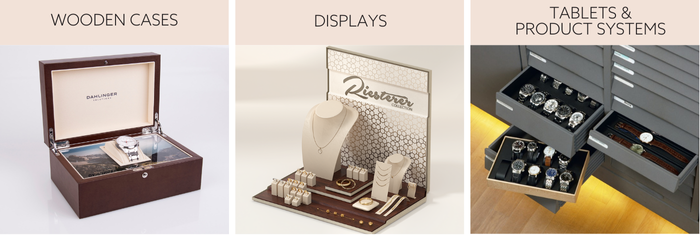
In the Black Forest, near the Swiss border, Dahlinger produces handmade boxes, displays and storage systems. Traditional woodworking meets modern CNC technology here.
The result: tailor-made luxury packaging that can be produced in small quantities. Perfect for limited editions or brands with high exclusivity requirements.
Made in Europe: Sustainable cardboard solutions for flexible quantities
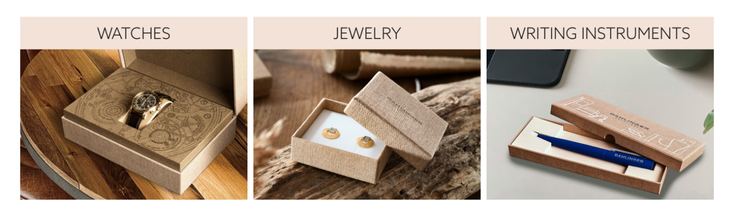
In addition to the German manufacture, Dahlinger offers cardboard packaging produced in Europe.
Advantages:
- Fast delivery times thanks to proximity to customers
- Low minimum quantities starting at 1,000 pieces
- High flexibility in design
- Significantly reduced transport emissions
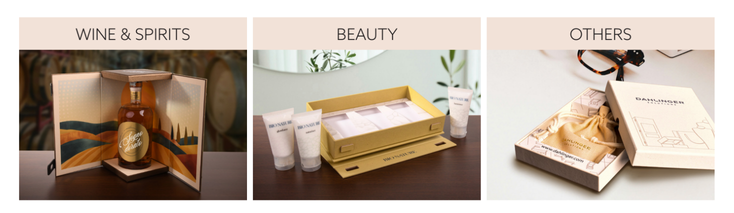
For brands in the DACH region, this means future-proof planning and sustainability. Without compromising on quality or aesthetics.
Mass customisation from Asia: when efficiency meets quality
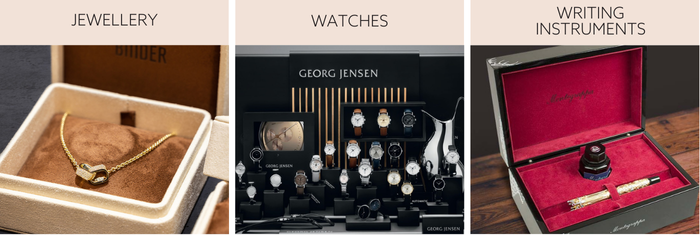
For large series, Dahlinger relies on long-standing partners in China. Thanks to its own office in Guangzhou, the entire production process is monitored. From development to delivery.
This means:
- consistently high quality,
- reliable delivery times,
- optimised logistics for global brands.
This combination of efficiency and quality is unique, especially for large quantities.
Case study Breitling: luxury meets circular economy
The collaboration with Breitling shows how luxury brands can rethink packaging.
- Material: 100% recycled PET (rPET)
- Construction: Monomaterial – fully recyclable
- Function: Not just a box, but also a practical travel case
- Logistics: Production in Asia – direct distribution to local markets
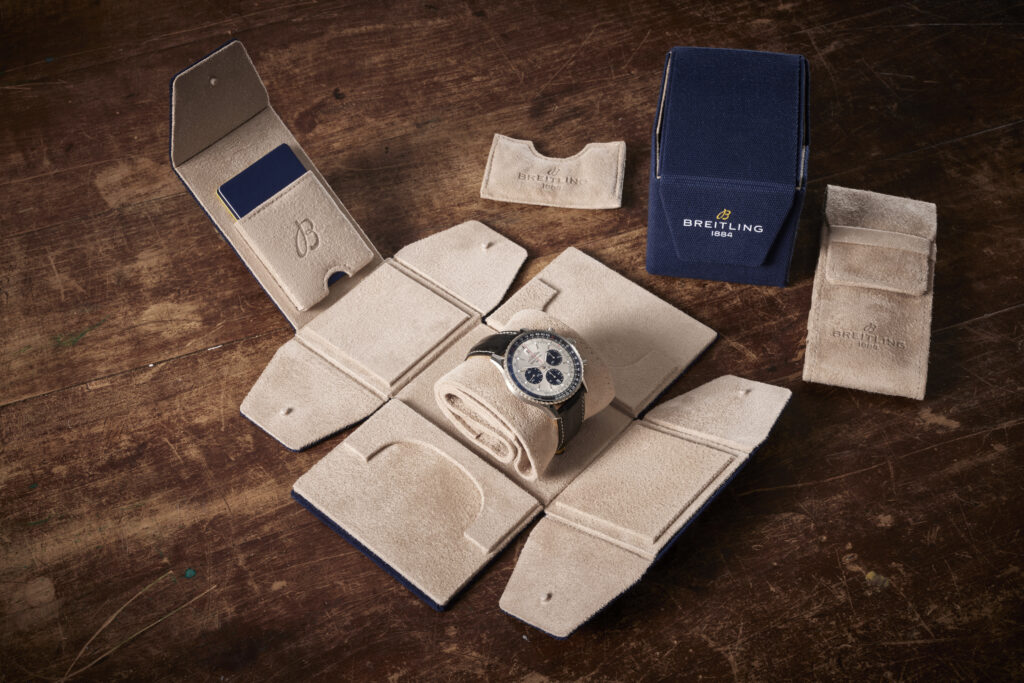
The project was awarded the Solar Impulse Foundation’s Efficient Solution Label as proof that luxury and sustainability are not only compatible, but also reinforce each other.
Future-proof packaging is not a trend – it is a strategy
The data is clear:
- luxury customers demand sustainability and they want proof, not empty marketing promises. Certificates such as FSC® or Ecovadis GOLD are therefore becoming indispensable tickets to the competition for credibility.
- The choice of material has a massive impact on CO₂: a direct comparison of plastic and cardboard boxes shows a reduction in emissions of over 50%.
- Regional manufacturing reduces risks, not only ecologically but also logistically. Shorter transport routes mean predictable delivery times, lower costs and less dependence on global disruptions.
- Case studies such as Breitling prove that luxury and the circular economy are not opposites, but can reinforce each other.
But being future-proof also means remaining adaptable. Markets and their requirements are changing rapidly. New materials, changing legal frameworks and technological innovations (e.g. smart packaging with QR codes or RFID integration) are expanding the possibilities and requiring brands to keep their finger on the pulse.
Another key argument is pricing and value perception. Many luxury brands report that they are able to successfully position their products as more valuable and achieve higher sales prices through high-quality packaging. Packaging thus becomes a revenue lever rather than a cost factor.
Packaging is also becoming a strategic tool in the context of the circular economy. Investing in recyclable mono-material solutions today not only reduces your carbon footprint, but also creates scenarios for secondary use. Packaging that is reused or stored extends brand presence far beyond the actual purchase.
The future therefore belongs to brands that see packaging as a strategic asset. They combine design excellence, environmental responsibility and technological innovation to sell not just products, but experiences.
The difference between a „pretty case“ and a future-proof packaging solution is crucial: while one gathers dust on the shelf, the other shapes the brand identity and remains in the minds and hearts of customers.
FAQs on future-proof luxury packaging
What does „future-proof packaging“ mean in the luxury segment?
Future-proof packaging refers to solutions that are both environmentally and economically sustainable. In the luxury segment, it’s not just about protection and design, but also about:
- CO₂ reduction through material selection (e.g. cardboard instead of plastic),
- Circular economy through recyclable mono-materials,
- Brand relevance through emotional packaging design,
- Scalability through flexible production in Europe and Asia.
This ensures that packaging remains future-proof even in the face of changing consumer demands and legal requirements.
Why is sustainability so important in luxury packaging?
Luxury customers are placing ever greater value on sustainable packaging solutions. Studies show that 20% of buyers actively check a brand’s sustainability credentials. FSC® or Ecovadis certification can therefore be a decisive factor in purchasing decisions. Sustainability not only strengthens the brand image, but also protects against regulatory risks. For example, in the context of the EU Packaging Regulation or the Circular Economy Strategy.
Which materials are suitable for sustainable luxury packaging?
The most important materials for future-proof packaging are:
- Cardboard (PAP): causes up to 50% less CO₂ than plastic and is fully recyclable.
- rPET: recycled plastic that can be reused in monomaterial solutions (example: Breitling case).
- Wood: for high-quality manufactured packaging that is durable and emotionally charged.
The principle of design for recycling is crucial: packaging should be designed in such a way that it can be recycled without separation.
What role does packaging play in brand perception in the luxury segment?
Packaging is the first physical point of contact between the brand and the customer. It conveys values such as exclusivity, sustainability and innovation. Gen Z and millennials in particular don’t just buy products, they buy brand values: 58% make purchasing decisions based on emotions. Well-designed packaging therefore not only increases the incentive to buy, but also brand loyalty. Often for years to come.
How can luxury brands make their packaging future-proof?
Brands should pay attention to three key factors:
- Sustainability: recyclable materials, short transport routes, transparent certifications.
- Design & emotionalisation: Create unboxing moments, understand packaging as part of brand staging.
- Flexible production: small series in Europe, large runs with controlled quality in Asia. Depending on requirements.
Dahlinger supports brands in combining these three aspects and developing tailor-made, future-proof packaging solutions.